Riesling
Riesling
1. Overview
Riesling is one of the world’s most distinctive and ageworthy white grapes, celebrated for its high acidity, aromatic purity, and exceptional ability to reflect terroir.
It originated along the Rhine and Mosel rivers and thrives where cool sunlight and large day–night temperature shifts allow slow, even ripening.
Styles span from bone-dry and mineral to richly sweet and botrytised, all marked by low to moderate alcohol and formidable longevity.
Unlike many whites, Riesling is rarely blended and seldom oak-aged; expression depends on stainless steel, neutral casks, or lees ageing rather than barrel toast.
2. Grape Characteristics
| Parameter | Riesling |
|---|---|
| Colour | White |
| Budding / Ripening | Early bud; late ripening |
| Vigour & Yield | Moderate; canopy needs management in cool years |
| Disease Sensitivity | Susceptible to botrytis (beneficial for sweet wines), mildew, frost |
| Preferred Soils | Slate, schist, limestone, sandstone, loess, volcanic basalt |
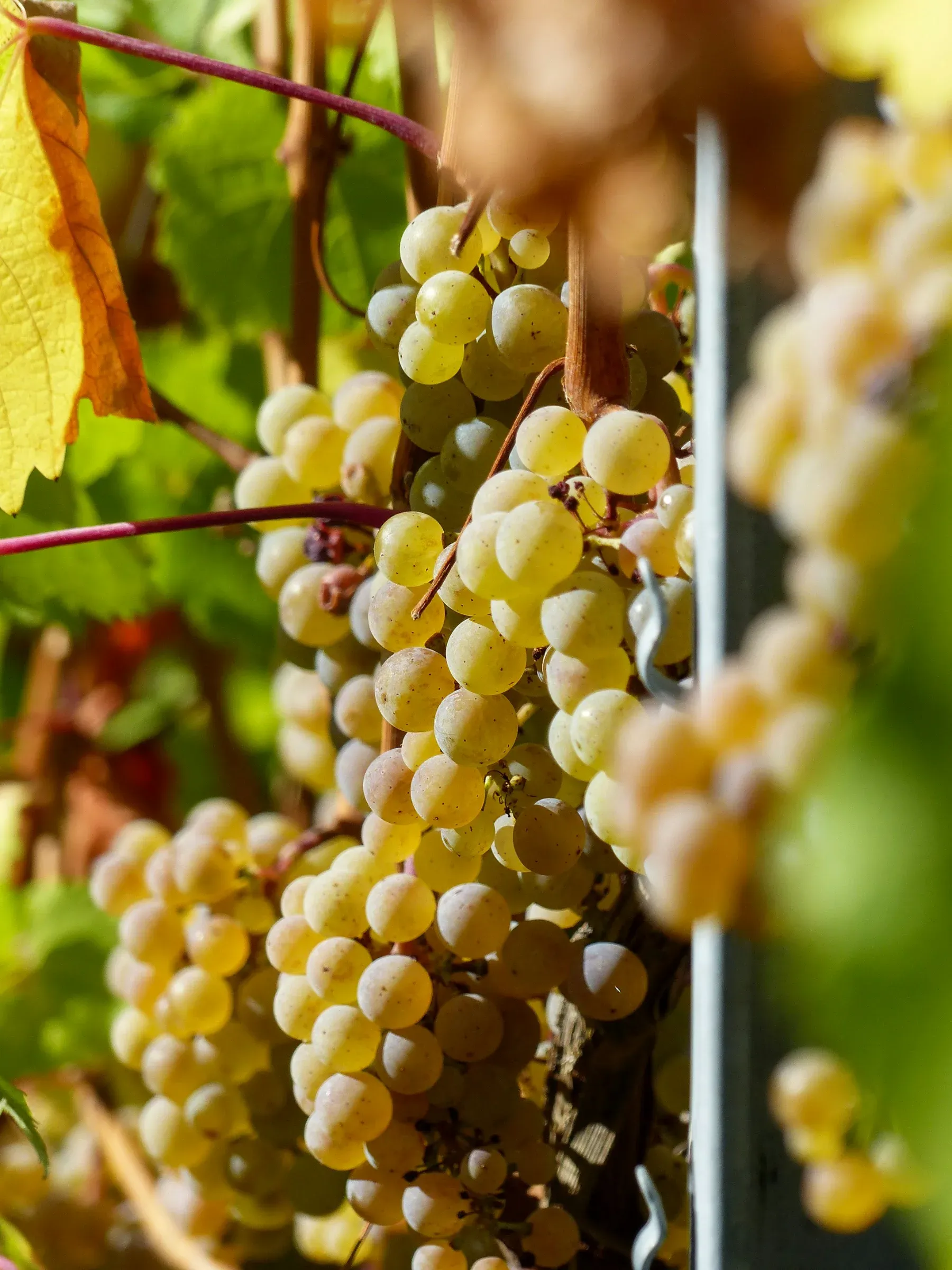
| Vine Characteristics | Small berries, compact bunches, slow sugar accumulation; aromatic precursors concentrated in pulp |
| Wine Traits | Very high acidity, low pH, citrus–floral to stone-fruit aromas in youth; honey/TDN/toast with age; strong site expression |
3. Major Growing Regions and Styles
Germany – The Reference Point
Germany holds roughly 24,000 ha of Riesling and remains its spiritual home.
The finest vineyards occupy steep, south-facing river slopes (Mosel, Rhine) whose heat-retentive slate and reflective rivers aid ripening in a marginal climate.
Climate & Soils:
- Avg. growing-season temperature: 14–15 °C
- Rainfall: 600–800 mm
- Soils: slate (Mosel), quartzite/sandstone (Rheingau), limestone/loess (Pfalz), volcanic and red sandstone (Nahe)
Styles:
Rieslings span from feather-light Kabinett to intense Trockenbeerenauslese under the Prädikat system, while Grosses Gewächs (GG) wines define elite dry Riesling.
Modern trends:
Spontaneous fermentation, long lees ageing, and a shift toward dry styles, especially in warmer regions.
Producers: Egon Müller, JJ Prüm, Keller, Dönnhoff, Robert Weil, Markus Molitor, Wittmann, Dr. Loosen (Mosel; also co-producer of Washington’s Eroica).
Austria – Precision and Drive
Around 2,000 ha planted, mostly in Wachau, Kamptal, Kremstal, Traisental.
Warm continental summers meet cool Alpine nights; rainfall 500–600 mm.
Soils vary: gneiss, granite, mica schist, loess, limestone.
Styles:
Typically dry, with ripe peach and apricot, firm acidity, and saline finish.
Wachau uses Steinfeder–Federspiel–Smaragd for ripeness levels; DAC systems define origin in Kamptal/Kremstal.
Modern trends:
Focus on single-vineyard expression, spontaneous fermentation, and minimal intervention.
Producers: FX Pichler, Knoll, Bründlmayer, Hirtzberger, Schloss Gobelsburg.
Alsace (France) – Dry and Gastronomic Power
Over 3,500 ha across the Vosges foothills.
Sheltered continental climate (~500 mm rain) and diverse soils — granite, schist, limestone, marl, sandstone, volcanic.
Styles:
Usually dry to off-dry, powerful, aromatic, and mineral.
Grand Cru vineyards (e.g., Schlossberg, Rangen) yield concentrated wines; VT and SGN denote late-harvest sweet styles.
Modern trends:
Return to genuinely dry expressions; widespread organic/biodynamic farming.
Producers: Trimbach, Zind-Humbrecht, Weinbach, Ostertag, Hugel.
Australia – Purity Under Screwcap
Centred on Clare and Eden Valleys, with outposts in Great Southern, Canberra, and Tasmania.
Climate & Soils:
- Warm days, cool nights; high diurnals
- Clare: 350–550 m, 600 mm rain, terra rossa over limestone/shale
- Eden: 450–500 m, granite/shale
Styles:
Almost entirely bone-dry, stainless-steel fermented; lime, green apple, talc; ages to honey and toast.
Modern trends:
Earlier picking for lower alcohol, lees ageing for texture, universal screwcap.
Producers: Grosset, Pewsey Vale, Henschke, Jim Barry, Frankland Estate.
New Zealand – Crisp and Aromatic
~700 ha in Marlborough, Central Otago, Nelson.
Cool maritime climate; gravelly alluvium, schist, and clay soils.
Styles:
From bone-dry to medium-sweet, all with vibrant acidity and moderate alcohol.
Central Otago tends to dry, Marlborough often off-dry.
Modern trends:
Sweetness scales on labels; small-batch wild ferments.
Producers: Framingham, Pegasus Bay, Felton Road, Seifried.
North America – Cool-Climate Promise
Top zones: Finger Lakes (New York), Washington State, Okanagan Valley (Canada).
Climate & Soils:
- Finger Lakes: shale & limestone; lakes moderate cold winters.
- Washington: semi-arid (200–300 mm); basalt & loess.
- Okanagan: dry continental; gravel & glacial deposits.
Styles:
Finger Lakes – brisk, delicate;
Washington – riper, fuller;
Okanagan – dry or late-harvest precision.
Modern trends:
Spontaneous ferments, longer lees ageing, and a shift to drier styles.
Producers: Eroica (Chateau Ste. Michelle × Dr. Loosen), Hermann J. Wiemer, Tantalus, Mission Hill.
Other Notable Regions
- South Africa: Elgin & Walker Bay – cool maritime; shale & sandstone; taut citrus wines.
- Chile: Southern valleys (Itata, Malleco) – volcanic soils; crisp, limey whites.
- UK: Kent & Sussex – emerging dry and sparkling styles.
4. Wine Styles and Classifications
| Style | Residual Sugar | Typical Alcohol | Examples |
|---|---|---|---|
| Dry (Trocken/Sec) | <9 g/L | 11–13 % | Austria, Alsace (modern), Australia |
| Off-Dry / Medium | 10–25 g/L | 10–11 % | Mosel Kabinett/Spätlese, NZ Medium |
| Sweet / Botrytised | 70–300+ g/L | 6–8 % | BA, TBA, Eiswein, VT, SGN |
5. Winemaking
- Vessels: stainless steel, large neutral oak (Fuder, Stück, Doppelstück), or concrete eggs.
- Fermentation: ambient yeasts common; MLF usually avoided.
- Lees: short for crispness or extended for texture.
- Sweet wines: late harvest, botrytis, or freezing (Eiswein).
- Ageing: minimal new oak; bottle age central to evolution.
6. Sensory Profile
- Youth: lime, lemon, green apple, peach, jasmine, slate.
- Maturity: honey, beeswax, petrol (TDN), toast, dried citrus.
- Structure: 7–10 g/L acidity; low–moderate alcohol; linear to waxy texture depending on site and style.
7. Leading Producers
Germany: Egon Müller (Saar), JJ Prüm (Mosel), Keller (Rheinhessen), Dönnhoff (Nahe), Robert Weil (Rheingau), Markus Molitor (Mosel), Wittmann (Rheinhessen), Dr. Loosen (Mosel; also Eroica in Washington).
Austria: FX Pichler, Knoll, Bründlmayer, Hirtzberger, Schloss Gobelsburg.
Alsace: Trimbach, Zind-Humbrecht, Weinbach, Ostertag, Hugel.
Australia: Grosset, Pewsey Vale, Henschke, Jim Barry, Frankland Estate.
New Zealand: Framingham, Pegasus Bay, Felton Road, Seifried.
North America: Eroica (Chateau Ste. Michelle × Dr. Loosen), Hermann J. Wiemer, Tantalus, Mission Hill.
8. Modern Trends and Innovations
- Dry-style resurgence: Grosses Gewächs and Trocken wines redefining German top tiers.
- Sustainability: expanding organic and biodynamic viticulture across Germany, Austria, Alsace.
- Closures: near-universal screwcap in Australia & NZ; wider adoption elsewhere.
- Minimal intervention: wild ferments, long lees contact, reduced sulfur.
- Climate adaptation: cooler aspects, higher sites, canopy shading to manage alcohol and TDN.
9. Summary.
Riesling is one of the most expressive and transparent white grapes in the world.
Its naturally high acidity and precise aromatics allow it to show clear differences of climate and soil — from the slate of the Mosel to the granite of the Wachau and the limestone of Alsace.
Across styles from dry to sweet, the best examples balance purity, freshness, and structure, producing wines that age gracefully and remain true to their origin.
Check your knowledge
Expert quiz