Rías Baixas
Rías Baixas: Viticulture, Winemaking, and Market Dynamics
1. Geographic and Environmental Overview
The Rías Baixas DO sits in Galicia, Spain’s cool, humid Atlantic northwest. It stretches along the estuarine inlets (“rías”) that give the region its name and natural climate moderation.
The DO covers about 4 000 ha of vineyards across five sub-zones:
- Val do Salnés – heartland; coolest and most maritime.
- O Rosal – on the Portuguese border along the Miño River; warmer and more floral.
- Condado do Tea – inland and warmest; fuller, riper wines.
- Soutomaior – tiny, granite-based hills near Vigo.
- Ribeira do Ulla – northernmost, cooler and slightly more continental.
Climate: cool-maritime; annual rainfall 1 400 – 1 800 mm; average temperature 12–13 °C.
Soils: mainly granite with sandy topsoil, plus patches of schist and alluvial clay.
Topography: sea level – 300 m; Atlantic breezes provide constant ventilation.
2. Grape Varieties
| Variety | Colour | Ripening | Average Yield (hl/ha) | Disease Sensitivity | Aromatics & Structure | Preferred Sites | Role / Style |
|---|---|---|---|---|---|---|---|
| Albariño | White | Early–mid | 63–70 | Mildew & botrytis if shaded | Citrus, peach, saline; high acid, medium+ alcohol | Granite sands near coast | Core grape; crisp to lees-aged & age-worthy styles |
| Treixadura (Trajadura) | White | Mid | 55–65 | Moderate mildew risk | Pear, white flowers; softer acidity | Warmer inland (Condado do Tea) | Adds body & floral lift in blends |
| Loureira (Loureiro) | White | Mid | 60–70 | Highly mildew-prone | Bay-leaf, lime, blossom | Sheltered maritime sites | Aromatic component in O Rosal blends |
| Caiño Blanco | White | Late | 50–55 | Thin skins → rot risk | Fennel, citrus zest; high acid | Exposed slopes | Adds tension & structure |
| Godello | White | Mid | 55–60 | Manageable | Quince, pear, chalky texture | Poor granite / schist soils inland | Textural, ageable minority white |
| Caiño Tinto | Red | Late | 45–55 | Mildew & rot risk | Red cherry, pepper, herbal; high acid | Warm, airy slopes | Fine, aromatic red |
| Espadeiro | Red | Mid | 55–60 | Thin skins → mildew | Strawberry, rose; low tannin | Coastal rows | Light, perfumed red |
| Sousón (Vinhão) | Red | Mid | 50–60 | Needs airflow | Black fruit, spice; firm tannin | Warm inland | Colour & structure in blends |
| Mencía | Red | Mid | 55–65 | Mildew & rot typical of humid Atlantic sites | Dark cherry, violet; fine tannin | Inland valleys | Minor reds; structure & age potential |
3. Soils and Sub-zone Characteristics
| Sub-zone | Dominant Soils | Fertility | Drainage / Temperature | Style Tendency |
|---|---|---|---|---|
| Val do Salnés | Granite + sand | Very low | Rapid drainage, cool roots | Linear, saline, citrus-driven wines |
| O Rosal | Granite + alluvium | Moderate | Warmer, balanced moisture | Floral, rounder Albariño blends |
| Condado do Tea | Granite + schist | Moderate | Warmest; large diurnal range | Fuller, riper whites; oak/lees work suits |
| Soutomaior | Granite / schist | Poor | Steep, windy, quick-draining | Concentrated, mineral wines |
| Ribeira do Ulla | Granite + siliceous sand | Patchy | Coolest; more continental | Crisp, delicate wines |
4. Production, Yields, and Regulation
- Founded: 1988.
- Area: ≈ 4 000 ha / ≈ 5 000 growers.
- Wineries: ≈ 180.
- Average yield: 60 – 70 hl/ha (Albariño max 80 hl/ha).
- Production: ≈ 300 – 400 000 hl per year (≈ 30 million L).
- Composition: > 95 % white wines.
- Minimum alcohol: 11 % abv.
- Blend rule: ≥ 70 % Albariño (most 100 %).
- Sparkling: “Rías Baixas Espumoso” authorised since 2018.
5. Viticulture: Disease, Mitigation, and Trellising
Main threats: downy & powdery mildew, botrytis, phomopsis; heavy autumn rains can cause rot.
Mitigation strategies
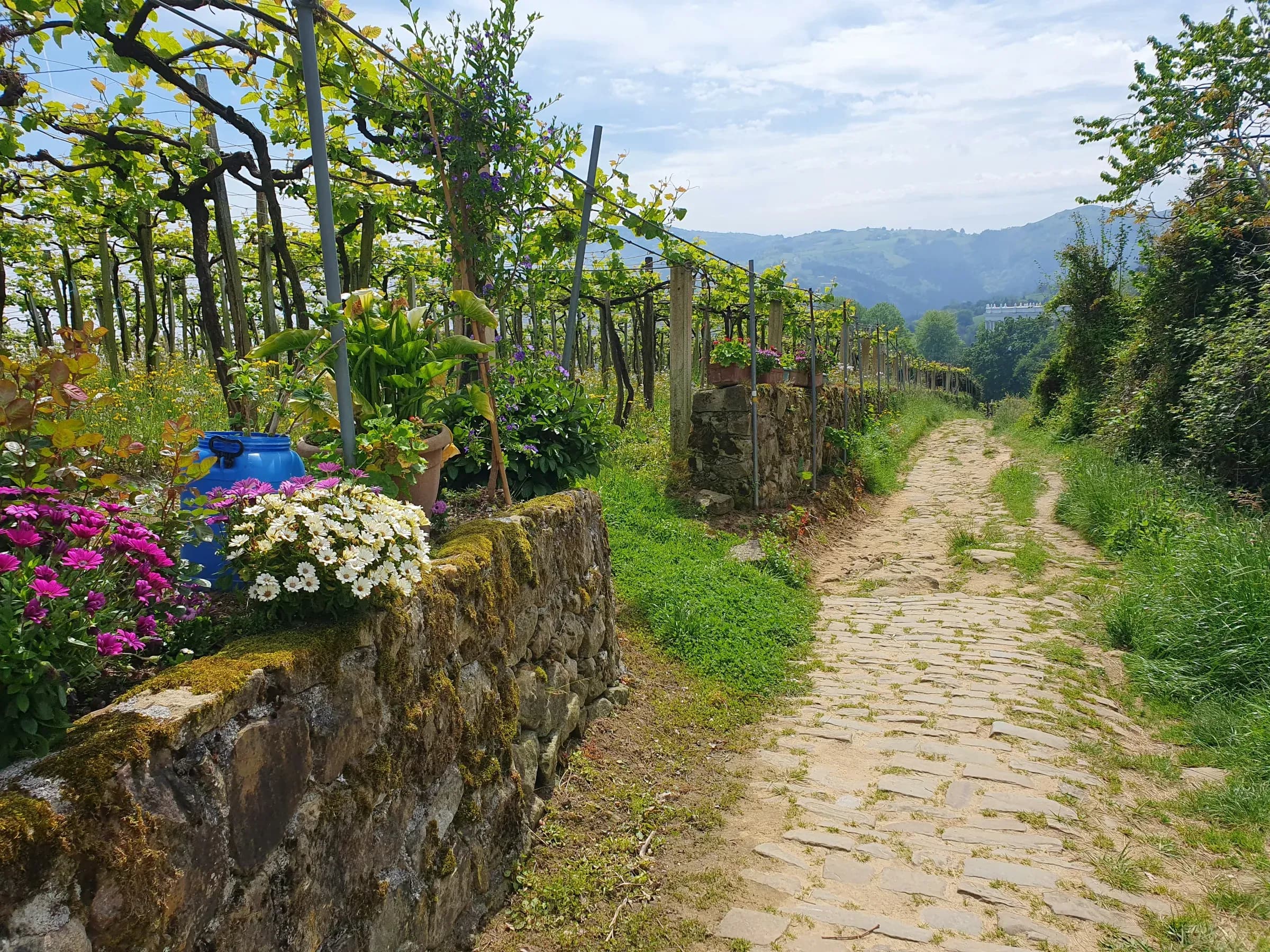
- Pergola (parra) – clusters 1.8–2.5 m high for airflow and drying.
- VSP (vertical-shoot positioning) – newer sites, mechanisable, lower yields.
- Canopy work: shoot thinning, leaf pulling, hedging.
- Organic / low-input trials: predictive spray models, biological controls.
- Site selection: windy slopes + free-draining granite soils.
- Harvest: multiple passes; quick pressing to avoid oxidation.
6. Winemaking and the Ageing Trend
Baseline: cool stainless-steel fermentation (14 – 18 °C) for aromatic purity.
Enhancements
- Lees ageing (sobre lías): 4 – 12 months → body & integration.
- Partial malolactic: softens acidity in warmer zones.
- Neutral oak / large foudres: adds subtle oxidative texture.
- Skin contact (short): light phenolic grip.
- Parcel vinification: emphasises terroir.
Why the shift toward age-worthy wines
- More reliable ripeness and phenolic maturity.
- Improved technical control for reductive protection.
- Sommelier demand for “serious Atlantic whites.”
Ageing trajectory: citrus → preserved lemon, stone fruit, chamomile, almond; saline depth.
Potential: best examples 5 – 10 years +.
7. High-Quality Reds of Rías Baixas
Reds (< 5 % of output) are gaining prestige in Condado do Tea, O Rosal, and select Salnés plots.
| Variety | Key Zones | Style Traits | Vinification |
|---|---|---|---|
| Caiño Tinto | Condado do Tea, O Rosal | Red-cherry, peppery, herbal; high acid, fine tannin | Whole-berry; neutral oak or steel; elegant & age-worthy |
| Espadeiro | Coastal O Rosal, Salnés | Light, floral, red-berry | Minimal extraction; chillable style |
| Sousón (Vinhão) | Warm inland | Deep colour, black fruit, firm tannin | Adds structure in blends |
| Mencía | Inland valleys | Dark fruit, mineral | Medium body; gentle oak |
Yields: 45 – 60 hl/ha typical.
Alcohol: 12 – 13 %; acidity: ≈ 6.5 g/L.
Notable producers: Forjas del Salnés (Leirana Tintos), Zárate (Tintilla), Nanclares y Prieto (Soverribas Tinto), Lusco (Caiño Tinto), Albamar (Tinto).
Potential: excellent — warming climate improves reliability.
8. White-Wine Styles and Leading Producers
| Style | Technique | Key Zones | Profile | Example Producers |
|---|---|---|---|---|
| Classic Coastal | Stainless; short lees | Salnés, Ulla | Taut citrus, saline finish | Do Ferreiro; Pazo de Señorans; Martín Códax |
| Lees-Textured | 6 – 12 m sobre lías | Salnés, Soutomaior | Creamy, stone-fruit depth | Zárate; Granbazán; Forjas del Salnés |
| River Blend (O Rosal) | Albariño + Treixadura / Loureira | O Rosal | Floral, pear, bay-leaf | Terras Gauda; Santiago Ruiz |
| Inland Richer (Condado) | Partial MLF; neutral oak | Condado do Tea | Fuller body, ripe citrus, soft spice | Fillaboa; Lusco |
| Single-Parcel / Late Release | Long lees; late bottling | Select slopes | Complex, mineral, age-worthy | Pazo de Señorans Selección de Añada; Do Ferreiro Cepas Vellas |
9. Co-operatives, Vineyard Ownership, and Sourcing
- Fragmentation: average holding < 1 ha.
- Co-operatives: vital for technical support and export scale (e.g., Martín Códax).
- Estate bottlers: own vineyards, parcel focus, lower yields (~ 55 hl/ha).
- Hybrid models: quality-linked contracts with bonuses for lower yields & balanced musts.
- Trend: co-ops investing in viticultural management teams to standardise quality.
10. Market, Risks, and Outlook
Production: ≈ 300 – 400 000 hl / year.
Exports: ≈ 40 % (USA, UK, Ireland, Germany).
Domestic: seafood-driven gastronomy support.
Price tiers: core €9 – 15; lees / parcel €20 – 45 +.
Emerging Risks and Competition
- Climatic volatility: rain spikes and mildew costs.
- Portugal’s Vinho Verde (Alvarinho): similar style at lower prices.
- Global Albariño expansion:
- Portugal (Monção e Melgaço): established and export-oriented.
- France (Languedoc & Côtes de Gascogne): newly authorised; growing fast.
- New Zealand: ≈ 150 ha; vibrant styles emerging in Marlborough.
- Australia: ≈ 100 – 150 ha; Tasmania & Adelaide Hills show promise.
- USA: coastal California, Oregon, Washington boutiques.
- Uruguay & Argentina: Atlantic and high-altitude experiments.
- Others: South Africa, Canada, UK early trials.
These plantings demonstrate Albariño’s global potential but challenge Rías Baixas to defend its distinct granite-and-Atlantic identity.
Strategic Outlook
- Emphasise sub-zone and single-vineyard expression.
- Promote lees-aged and late-release tiers to cement premium status.
- Diversify with Treixadura / Loureira blends and reds.
- Strengthen sustainability and co-operative technical leadership.
Overall Assessment
Rías Baixas remains Spain’s flagship Atlantic region, uniting maritime freshness with precise modern winemaking.
Its strength lies in the diversity of five sub-zones, a growing portfolio of varieties and styles, and a deep commitment to sustainability and terroir transparency.
Balancing its Albariño legacy with innovation across reds, blends, and sparkling styles will define its next decade of success.
Check your knowledge
Expert quiz