Alsace Spotlight
Alsace Viticulture, Winemaking, and Production Overview
1. Climate and Environment
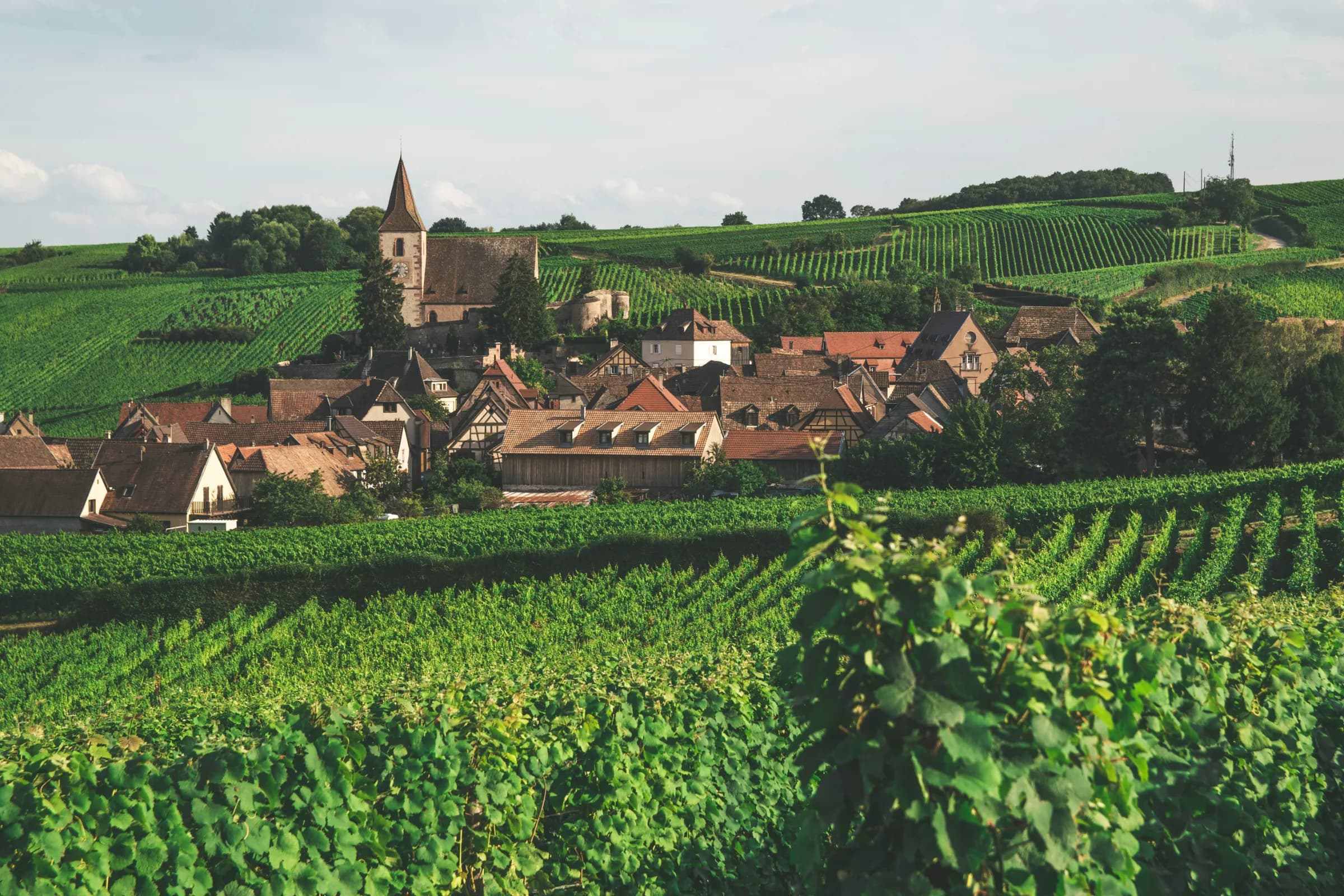
Alsace lies in northeastern France, between the Vosges Mountains and the Rhine River, bordering Germany. It has a semi-continental climate — one of the driest and sunniest in France — due to the rain shadow of the Vosges, which blocks Atlantic rainfall.
Average annual rainfall is 500–600 mm, mostly in spring and autumn. Summers are warm, autumns long and dry, allowing gradual ripening and excellent aromatic development. Frost and hail are the main climatic hazards.
Low humidity limits fungal disease, making organic and biodynamic viticulture widespread. The long growing season encourages full phenolic maturity and the production of aromatic white wines with natural acidity and purity.
2. Soils and Terroir
Alsace sits on a mosaic of ancient fault lines, giving rise to one of Europe’s most diverse soil profiles — granite, limestone, marl, schist, volcanic rock, clay, and sandstone — often within the same hillside.
- Granite and sand: Fast-draining, light soils; produce high-acid, aromatic wines.
- Limestone and marl: Retain moisture; yield structured, full-bodied wines.
- Volcanic and clay: Add richness, spice, and density, ideal for Gewurztraminer.
Vineyards occupy mostly east- and southeast-facing slopes along the Vosges foothills, benefiting from morning sun, excellent drainage, and shelter from westerly rain and wind.
3. Grape Varieties and Key Characteristics
White Grapes
| Variety | Budburst / Ripening | Skin Thickness | Acidity | Flavour Intensity | Typical Flavours | Role / Style | Main Hazards |
|---|---|---|---|---|---|---|---|
| Riesling | Mid / Late | Thin | High | High | Lime, green apple, stone fruit, petrol (TDN), mineral | Signature grape; dry to off-dry, long-lived | Frost; drought on sandy soils |
| Gewurztraminer | Early / Early–Mid | Thick | Low | Very High | Lychee, rose, ginger, exotic spice | Full-bodied, aromatic, often off-dry | Coulure; rot in wet vintages |
| Pinot Gris | Mid / Mid–Late | Medium | Medium | High | Peach, smoke, honey, spice | Rich, textural; dry to sweet styles | Botrytis; grey rot |
| Muscat (d’Alsace / Ottonel) | Early / Early | Thin | Medium–High | High | Grape, orange blossom, floral | Aromatic and fresh; usually dry | Frost; coulure |
| Pinot Blanc / Auxerrois Blanc | Early / Mid | Medium | Medium | Medium | Apple, pear, almond | Used mainly for Crémant d’Alsace (~85–90% of crop); some soft still wines | Frost; downy mildew |
| Sylvaner | Early / Early | Thin | Medium–High | Medium | Green apple, herbs, floral | Out of fashion; old-vine parcels (Mittelbergheim, Bas-Rhin) give concentrated, complex wines | Frost; mildew |
| Klevener de Heiligenstein (Savagnin Rose) | Early / Mid | Thick | Medium | Medium–High | Pink grapefruit, spice, faint lychee | Rare, historic local wine; dry, subtle spice | Frost; small area of cultivation |
Pinot Gris vs. Pinot Grigio: The same variety but different clones and styles. Alsace Pinot Gris (older clones, lower yields) gives fuller, spicier, sometimes off-dry wines; Italian Pinot Grigio is lighter, higher-yielding, and fresher.
Petrol in Riesling (TDN formation): The aroma arises from 1,1,6-trimethyl-1,2-dihydronaphthalene (TDN), a compound formed during aging, especially from grapes grown in sunny, dry sites with high carotenoid levels. Not all Rieslings show it; cooler vineyards tend to produce purer fruit tones.
Red Grapes
| Variety | Budburst / Ripening | Skin Thickness | Acidity | Tannins | Flavour Intensity | Typical Flavours | Role / Style | Main Hazards |
|---|---|---|---|---|---|---|---|---|
| Pinot Noir | Early / Mid | Thin | Medium | Medium, fine | Medium | Red cherry, cranberry, spice, smoke | Light, fruity reds; increasingly oak-aged | Frost; mildew |
Why Ottrott is notable for Pinot Noir
Ottrott, near Obernai in the Bas-Rhin, has iron-rich sandstone and clay-limestone soils that retain warmth and moisture, aiding even ripening. Its southern and southeastern exposures provide strong sunlight, while the Vosges’ shelter prevents excess rain and wind. Warm days and cool nights encourage colour, tannin development, and fresh acidity.
These conditions make Pinot Noir d’Ottrott one of the few Alsatian reds capable of depth and structure. Its history dates to the Middle Ages, and modern wines show ripe red fruit, delicate spice, and silky texture.
4. Vineyard Management and Yields
Vineyard density averages 4,000–6,000 vines/ha, using Guyot systems. Steep Grand Cru slopes are terraced for erosion control.
Typical yields:
- Alsace AOC: ~80 hl/ha
- Grand Cru AOC: ~55 hl/ha
- Crémant d’Alsace AOC: 80–100 hl/ha
Main hazards: spring frost, hail, and drought in lighter soils. Dry conditions keep disease pressure low, supporting sustainable viticulture.
5. Appellations and Classification
- AOC Alsace: ~70% of total production; varietal wines labelled by grape (e.g., Riesling, Pinot Gris, Gewurztraminer).
- AOC Alsace Grand Cru: 51 classified vineyard sites; permitted grapes — Riesling, Pinot Gris, Gewurztraminer, Muscat. Lower yields, vineyard + grape name required.
- AOC Crémant d’Alsace: Traditional-method sparkling wines, mainly from Pinot Blanc, Auxerrois, Pinot Gris, and Pinot Noir.
For Crémant d’Alsace, growers must declare in advance which vineyard parcels are intended for Crémant production each year. This ensures the fruit meets AOC regulations — including lower maximum yields, early harvesting for higher acidity, and mandatory hand-picking.
Klevener de Heiligenstein is a local AOC mention for Savagnin Rose grown only around Heiligenstein.
6. Winemaking Practices
Whites: Cool, slow fermentation in stainless steel or large neutral foudres. MLC avoided for Riesling and Muscat, optional for Pinot Gris and Gewurztraminer. Lees aging adds texture; wines bottled early to retain aromatics.
Reds: Gentle extraction; aging in stainless steel or oak (especially for Ottrott and premium cuvées).
Sweet Wines:
- Vendanges Tardives (VT): Late-harvested; dry to medium-sweet.
- Sélection de Grains Nobles (SGN): Botrytized, rich, and long-lived.
7. Annual Production and Variation
Alsace produces 1.1–1.2 million hL per year (≈110–120 million litres).
Approximate breakdown:
- Still white wines: ~75%
- Red and rosé (Pinot Noir): ~10%
- Crémant d’Alsace: ~25% (grape sourcing overlaps)
Strong vintages: 2010, 2015, 2018, 2019, 2020.
Challenging vintages: 2013, 2021 — frost and mildew reduced yields.
8. Subregions and Styles
- Bas-Rhin (north): Cooler; higher acidity; includes Klevener de Heiligenstein and Pinot Noir d’Ottrott.
- Haut-Rhin (south): Warmer; home to most Grand Crus (Schlossberg, Brand, Rangen, Furstentum).
- Vosges foothills: Best-exposed vineyards, low yields, top terroir.
- Rhine plain: Fertile, high-yielding soils; simpler wines.
Leading producers: Trimbach, Zind-Humbrecht, Hugel et Fils, Weinbach, Marcel Deiss, Albert Mann, Schlumberger, Ostertag.
9. Land Ownership and Production
Less fragmented than Burgundy; dominated by family domaines, cooperatives, and négociants (e.g., Wolfberger, Cave de Turckheim).
Most wines are varietally labelled with vintage; blends like Edelzwicker or Gentil fall under generic AOC Alsace.
10. Reputation and Status
- Dry, sunny climate ensures ripe, expressive fruit.
- Varietal labelling gives clarity to consumers.
- Diverse soils and microclimates allow stylistic breadth.
- Benchmark aromatic whites: Riesling, Gewurztraminer, Pinot Gris.
- Growing respect for Grand Cru Rieslings and fine Pinot Noir.
Although undervalued compared to Burgundy, Alsace offers exceptional purity and longevity.
11. Recent Trends
- Shift toward drier styles and terroir focus.
- Crémant d’Alsace now ~25% of production.
- Organic and biodynamic viticulture mainstream.
- Revival of old-vine Sylvaner for concentrated, characterful wines.
- Renewed interest in field blends and co-plantations.
- Expanding ambition for Pinot Noir, especially in Ottrott and Haut-Rhin.
12. Advantages and Disadvantages
Advantages:
- Warm, dry climate; long ripening season.
- Diverse soils → varied styles.
- Clear varietal labelling.
- Low disease pressure enables sustainability.
Disadvantages:
- Frost, hail, and drought risk.
- Confusion over sweetness levels.
- Heavy export reliance.
13. Summary
Alsace’s wines reflect its sunshine, complex geology, and meticulous viticulture.
Riesling, Gewurztraminer, and Pinot Gris dominate, producing aromatic, age-worthy wines of purity and minerality.
Pinot Noir, particularly from Ottrott, adds a distinctive red counterpart.
Pinot Blanc/Auxerrois underpin Crémant d’Alsace, with strict parcel declaration and early harvests ensuring finesse.
Old-vine Sylvaner and Klevener de Heiligenstein preserve the region’s heritage.
Alsace remains one of Europe’s most distinctive fine-wine regions, combining Germanic grapes with French precision to create wines of elegance, clarity, and terroir expression.
Check your knowledge
Expert quiz