Sauvignon Blanc
1. Grape and Viticultural Characteristics
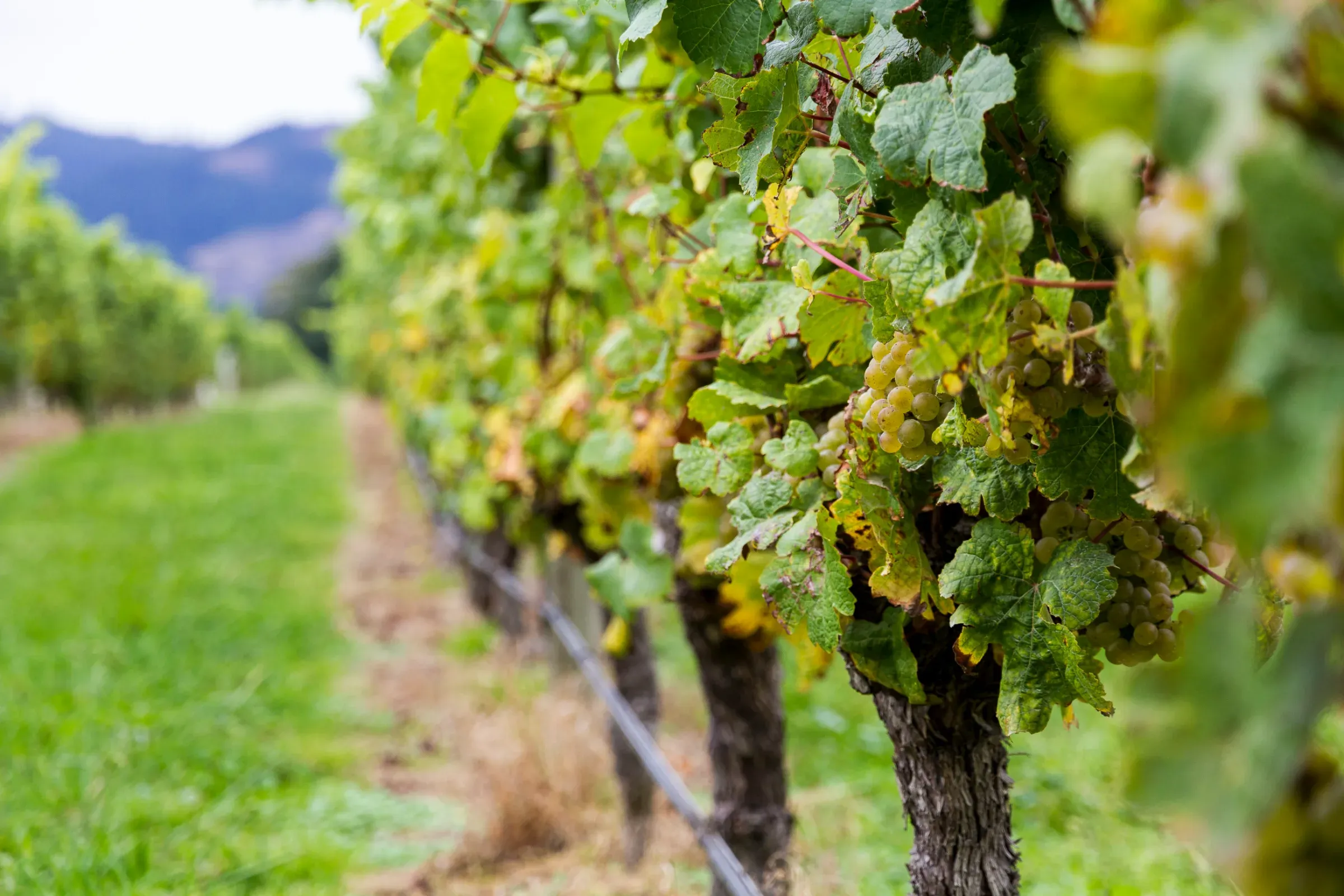
Origins and Viticulture
Sauvignon Blanc originated in western France — most likely the Loire Valley or Bordeaux — and today covers more than 120,000 ha worldwide, making it one of the most widely planted white varieties.
It buds early and ripens early, thriving in cool to moderate climates that preserve acidity and aromatic freshness.
The vine is vigorous and requires strict canopy management to limit shading and vegetative growth. Sunlight exposure strongly influences aromatic composition: methoxypyrazines (green pepper, grass) decrease, while thiols (passionfruit, grapefruit) increase with greater ripening.
The best results come from poor, well-drained soils, which limit vigour and yield.
Viticultural Hazards: Early frost, mildew, botrytis in humid climates, and sunburn in hot regions.
Advantages: Naturally high acidity, pronounced aromatics, wide adaptability, and strong global consumer recognition.
2. Regional Styles, Soils, and Production
2.1 Bordeaux (Dry Whites)
- Area: ~5 000 ha of Sauvignon Blanc; total dry-white production roughly a few hundred thousand hectolitres annually (varies by vintage).
- Climate: Maritime, moderated by the Atlantic; rainfall around 900 mm/year.
- Soils: Gravel and sand dominate, with some clay and limestone; excellent drainage.
- Yields: 45–55 hl/ha in top estates; up to 60–65 hl/ha permitted for Bordeaux AOC.
- Style: Commonly blended with Sémillon and Muscadelle; oak-fermented and lees-aged wines with body, texture, and citrus or stone-fruit depth.
- Market: Niche but premium, performing well in fine-dining and collector markets.
2.2 Loire Valley (Sancerre, Pouilly-Fumé, Touraine)
- Area:
- Sancerre AOC ≈ 3 000 ha
- Pouilly-Fumé AOC ≈ 1 300–1 400 ha
- Touraine AOC ≈ 5 000 ha
- Production: Touraine produces ≈ 220 000 hl per year (all colours); Sancerre roughly similar order of magnitude across vintages.
- Climate: Cool continental; significant vintage variation.
- Soils: Kimmeridgian limestone, marl, and flint (silex). Flint adds smoky “gunflint” notes; limestone yields linear, mineral wines.
- Yields:
- Sancerre: 65 hl/ha (max); 50–60 typical.
- Pouilly-Fumé: 65 hl/ha (max); 50–58 typical.
- Touraine: 70 hl/ha (max); 60–70 typical.
- Style: Elegant, high-acid, citrus and green-fruit flavours with minerality and precision.
- Market: Internationally respected for terroir-driven expression and consistency.
2.3 Pays d’Oc (IGP Languedoc)
- Scale: The Pays d’Oc IGP is France’s largest single source of varietal Sauvignon Blanc by volume. The IGP produces about 6.8 million hl of wine annually (2021), with Sauvignon Blanc among the leading white grapes.
- Climate: Warm Mediterranean with maritime influence; dry summers and mild winters.
- Soils: Mixed — clay-limestone inland, alluvial and sandy near the coast; low rainfall aids disease control.
- Yields: Legally capped at 80 hl/ha, typically 70–80 hl/ha.
- Style: Broad range — from crisp, stainless-steel-fermented citrus wines to riper, tropical-fruited examples. High sunlight and low humidity preserve freshness even at generous yields.
- Winemaking: Mostly stainless steel; some partial malolactic or oak for texture.
- Market: Focused on value and accessibility for international supermarkets and brands; also a base for certified organic and vegan wines.
- Distinctiveness: Varietal-labelled wines prioritising freshness rather than terroir hierarchy — the gateway to French Sauvignon Blanc for many consumers.
2.4 New Zealand (Marlborough and Others)
- Area: 28 109 ha Sauvignon Blanc nationwide (2024); Marlborough ≈ 25 000 ha.
- Production: Approx. 2 million hl (2023 vintage, variable).
- Climate: Cool maritime; long sunshine hours, strong UV exposure.
- Soils: Alluvial gravels, free-draining loams.
- Yields: 55–75 hl/ha typical.
- Style: Intensely aromatic; passionfruit, guava, lime, and capsicum; crisp and unoaked.
- Market: Defines the global benchmark; accounts for ≈ 85 % of New Zealand exports and > NZ $1.3 billion export value.
2.5 Chile (Casablanca, San Antonio, Leyda, Aconcagua Costa)
- Area: ≈ 14 500 ha Sauvignon Blanc; ≈ 800 000 hl production.
- Climate: Cool maritime, moderated by the Humboldt Current.
- Soils: Sandy and granitic; moderate fertility.
- Yields: 50–65 hl/ha.
- Style: Medium-bodied, citrus- and tropical-fruit balance; clean and restrained compared with New Zealand.
- Market: Strong value positioning; notable export growth in the £10–20 retail bracket.
2.6 South Africa (Elgin, Durbanville, Stellenbosch)
- Area: ≈ 9 000–10 000 ha.
- Production: Hundreds of thousands of hectolitres annually (variable by vintage; SB is one of South Africa’s leading white cultivars).
- Climate: Coastal Mediterranean; cool ocean breezes.
- Yields: 45–60 hl/ha.
- Style: Bright acidity, grapefruit, fig, and mineral balance; some barrel-aged “Reserve” wines.
- Market: Balanced domestic and export demand; competitive in premium supermarket and restaurant segments.
2.7 USA (California, Washington)
- Area: Several thousand hectares (California ≈ 6 000 ha).
- Production: Varies widely by vintage and region; Sauvignon Blanc remains a minor but important white variety.
- Climate: Warm Mediterranean moderated by coastal fog.
- Yields: ≈ 60–80 hl/ha typical.
- Style: From crisp stainless-steel “Sauvignon Blanc” to richer, oak-aged “Fumé Blanc.”
- Market: Strong domestic consumption; smaller but stable export footprint.
2.8 Australia (Adelaide Hills, Margaret River, Tasmania)
- Area: ≈ 6 000 ha; ≈ 400 000 hl production.
- Climate: Cool to moderate maritime and elevated inland zones.
- Yields: 55–65 hl/ha.
- Style: Adelaide Hills = crisp, grassy wines; Margaret River = Sauvignon/Sémillon blends for richer styles.
- Market: Focused on domestic premium whites and emerging Asian exports.
3. Winemaking Techniques and Style Outcomes
Harvest Timing
- Early harvest: Highlights pyrazines, high acidity, citrus and herbal notes.
- Later harvest: Emphasises tropical fruit and roundness; may reduce typicity if overripe.
Fermentation and Ageing
- Stainless steel (12–16 °C): Preserves purity and freshness — Loire, NZ, Chile.
- Barrel fermentation and lees ageing: Adds weight and complexity — Bordeaux, California.
- Wild fermentation: Increasingly used for texture and complexity.
- Malolactic conversion: Usually blocked; partial MLF softens acidity in oaked styles.
Lees and Blending
Lees contact adds creaminess; blending with Sémillon (Bordeaux) or multi-vineyard blending (NZ) achieves stylistic balance.
4. Comparative Yield and Style Analysis
| Region | Legal Yield (hl/ha) | Typical Practice | Annual Production | Stylistic Outcome |
|---|---|---|---|---|
| Sancerre (Loire) | 65 | 50–60 | ≈ 300 000 hl | Concentrated, mineral, high acid |
| Pouilly-Fumé (Loire) | 65 | 50–58 | ≈ 70 000 hl | Flinty, smoky, precise |
| Touraine (Loire) | 70 | 60–70 | ≈ 220 000 hl | Fruity, early-drinking |
| Graves / Pessac-Léognan (Bordeaux) | 60–65 | 45–55 | hundreds of thousands hl | Textural, oak-aged |
| Pays d’Oc (IGP) | 80 | 70–80 | ≈ 6.8 million hl (total IGP) | Aromatic, accessible, high-volume |
| Marlborough (New Zealand) | – | 55–75 | ≈ 2 million hl | Intense, tropical and grassy |
| Chile (Casablanca, Leyda) | – | 50–65 | ≈ 800 000 hl | Citrus-led, balanced |
| South Africa | – | 45–60 | variable (~hundreds thousand hl) | Grapefruit, zesty acidity |
| California (North Coast) | – | 60–80 | variable | Rich, oak-influenced |
| Australia (Adelaide Hills) | – | 55–65 | ≈ 400 000 hl | Fresh, herbaceous, blended styles |
Interpretation:
Low yields (Loire, Bordeaux) bring structure and terroir precision.
Moderate yields (NZ, Chile, South Africa) balance fruit intensity and freshness.
High yields (Pays d’Oc, IGP regions) enable accessible, high-volume wines.
5. Future Outlook
Sauvignon Blanc dominates global white-wine sales, but its evolution depends on diversity, terroir expression, and climate adaptation.
Trends and Forward-Looking Insights
- Climate Adaptation: Warming in Loire and Bordeaux advances harvests by up to two weeks, driving investment in higher-altitude and coastal sites. Cooler zones such as Tasmania, Chile’s coast, and South Africa’s Cape South Coast are key to maintaining freshness.
- Terroir and Premiumisation: The market is shifting away from uniform, high-volume styles toward site-specific, textural wines. Sub-regional distinctions in Sancerre, Marlborough, and Leyda Valley are leading examples.
- Innovation in Production: Techniques such as lees ageing, wild fermentation, amphora ageing, and selective oak are adding complexity and longevity.
- Economic and Market Dynamics: Sauvignon Blanc’s reputation as a reliable, high-yield, quick-return variety supports profitability, but oversupply and style fatigue (notably in Marlborough and Pays d’Oc) require diversification and terroir focus.
- Sustainability and Regulation: Growing emphasis on certifications (HVE, Sustainable Winegrowing NZ) and tighter yield management to preserve quality and resources.
- Competition: Increasing rivalry from aromatic whites such as Albariño, Grüner Veltliner, and Vermentino, which share freshness and versatility.
Overall Assessment
Sauvignon Blanc’s enduring strengths — vibrancy, adaptability, and recognisable style — ensure its continued global success.
Its future lies in balancing freshness with complexity, fostering regional differentiation, and strengthening climate and market resilience.
From the flinty precision of the Loire and structured depth of Bordeaux to the exuberance of Marlborough and the accessibility of Pays d’Oc, Sauvignon Blanc remains one of the world’s most dynamic and versatile white wines.
Check your knowledge
Expert quiz