Priorat
1. Overview
Priorat, in the province of Tarragona (Catalonia), is one of only two Spanish regions with DOQ/DOCa status, alongside Rioja.
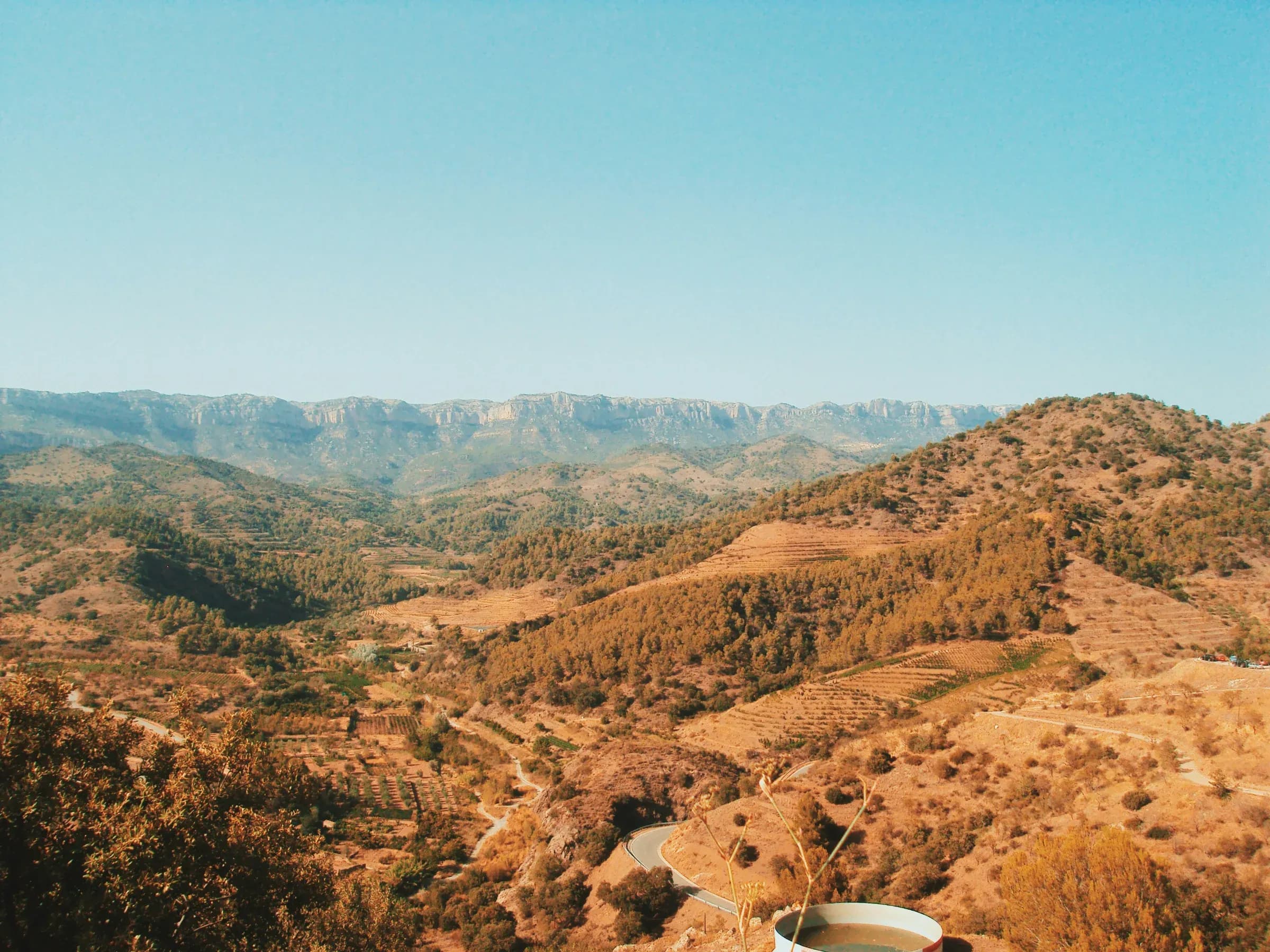
It is famed for its steep terraced vineyards, slate soils (llicorella), and old-vine Garnatxa (Grenache) and Carinyena (Carignan) that yield dense, powerful reds with a distinctive mineral edge.
The DOQ covers 12 village zones (Vins de Vila) — Bellmunt, Gratallops, El Lloar, La Morera de Montsant, Porrera, Poboleda, Scala Dei, Torroja, La Vilella Alta, La Vilella Baixa, Masos de Falset, and Solanes del Molar — each with its own character.
2. History and Development
Viticulture here began with the Carthusian monks of Scala Dei in the 12th century, who first cultivated vines on these rugged hillsides.
After centuries of decline following phylloxera, Priorat was reborn in the late 1980s through the “Clos” movement, led by René Barbier, Álvaro Palacios, Daphne Glorian, and others.
Their small, high-quality bottlings proved that Priorat could rival the world’s best reds.
Today, the region’s “Els Noms de la Terra” classification pyramid formalises this terroir-driven approach, with designations from DOQ Priorat up to Gran Vinya Classificada.
3. Geography, Climate, and Soils
- Altitude: 100–750 m
- Climate: Mediterranean with continental influence – hot, dry summers and cool nights
- Rainfall: 400–600 mm per year
- Average temperature: ~14 °C
- Soils: Llicorella (slate with mica and quartz) – thin, poor, and highly heat-retentive, forcing vines to root deep for water and minerals
The result is extremely low vigour, tiny yields (often 20–25 hl/ha), and grapes with high phenolic concentration.
The combination of sun, slope, and stone defines Priorat’s trademark intensity and mineral depth.
4. Grape Varieties
| Variety | Colour | Budding / Ripening | Vigour & Yield | Disease Sensitivity | Preferred Soils | Vine Characteristics Summary | Wine Style & Traits |
|---|---|---|---|---|---|---|---|
| Garnatxa (Garnacha Tinta) | Black | Early bud; late ripening | High; needs crop control | Coulure in cool bloom | Warm llicorella terraces | Heat-tolerant, high sugar potential | Red and black fruit, herbs, spice; generous alcohol and perfume |
| Carinyena (Carignan) | Black | Late bud; late ripening | Moderate; low on old vines | Mildew if humid | Poor slate slopes | Thick skins, high acidity | Deep colour, firm tannins, freshness and structure |
| Syrah | Black | Mid; mid-late | Moderate | Sunburn risk in hot sites | Cooler exposures | Adapts to slate if not overripe | Dark fruit, pepper, body and flesh |
| Cabernet Sauvignon | Black | Late | Moderate–low on poor soils | Ripening risk at altitude | Warmest exposures | Small berries, thick skins | Cassis, cedar; structure and ageing potential |
| Merlot | Black | Early; mid | High vigour | Coulure risk | Cooler, deeper pockets | Broad leaves; vigorous | Plum, chocolate; softens blends |
| Garnatxa Blanca | White | Early; mid-late | Moderate | Oxidation post-harvest | Calcareous-slate mix | Thick skins; high extract | Pear, quince, almond; textural whites |
| Macabeu, Pedro Ximénez | White | Mid; mid-late | Moderate | Botrytis risk | Airy, stony sites | Neutral aromatics | Adds roundness or oxidative depth |
5. Viticulture and Production Structure
- Vineyard area: just over 2,000 ha
- Growers: ~575
- Wineries: ~109
- Yields: Max 39 hl/ha (red) and 52 hl/ha (white), but top wines rarely exceed 20–25 hl/ha
- Training: Old bush vines dominate; terraces (costers) prevent erosion; hand-harvested only
- Irrigation: Minimal – almost entirely dry-farmed
- Vine age: Many parcels 50–100+ years old, especially Carinyena
The topography makes mechanisation nearly impossible, reinforcing the region’s artisanal nature.
6. Winemaking
Traditionally, wines were fermented and aged in 225 L French oak barriques with long macerations, yielding massive, concentrated reds.
Modern producers now seek balance and finesse through:
- Earlier picking for freshness
- Partial whole-cluster fermentation (especially Garnatxa)
- Ageing in large oak, concrete, or amphora instead of small new barrels
- Alcohol levels typically 14–15.5 %, total acidity 5–6 g/L, and pH 3.2–3.5
7. Styles and Sensory Profile
- Red wines: Deep colour; flavours of black cherry, plum, licorice, Mediterranean herbs, and graphite; firm but fine tannins; long, mineral finish.
- White wines: Mostly Garnatxa Blanca; pear, fennel, almond; rich yet saline and fresh; often barrel-fermented.
- Rosats: Small production, dry and savoury with herbal tones.
- Ageing potential: Top reds can evolve gracefully for 20+ years.
8. “Els Noms de la Terra” – Classification Pyramid
| Level | Description |
|---|---|
| DOQ Priorat | Grapes from anywhere in the region |
| Vi de Vila (Village Wine) | Grapes from one of 12 delimited village zones; stricter yield and varietal rules |
| Vi de Paratge (Site Wine) | From one of 459 named sites; even lower yields and older vines |
| Vinya Classificada | Single classified vineyard of historical significance |
| Gran Vinya Classificada | Exceptional single vineyard of proven track record (currently three: L’Ermita, Mas de la Rosa, 1902 Tossal d’en Bou) |
This system, introduced in 2019, highlights the region’s shift toward site-specific expression rather than blend-driven styles.
9. Villages and Subzones
| Village | Elevation | Style Traits |
|---|---|---|
| Gratallops / El Lloar / La Vilella Alta & Baixa | 200–400 m | Warmest sites; dense fruit, classic Clos style |
| Porrera | 300–600 m | Cooler, higher; focused acidity, long ageing potential |
| Poboleda | 400–650 m | Freshness, elegance, later ripening |
| La Morera & Scala Dei | 350–700 m | Coolest, stoniest sites; floral and mineral finesse |
10. Production Overview
| Metric | Data / Range | Notes |
|---|---|---|
| Vineyard area | ~2,000 ha | DOQ figure |
| Growers / Wineries | ~575 / ~109 | DOQ figure |
| Rainfall | 400–600 mm | Very dry climate |
| Avg. temperature | ~14 °C | Hot days, cool nights |
| Yields | 20–25 hl/ha typical | Extremely low |
| Main grapes | Garnatxa, Carinyena | 70 % of vineyard area |
| Annual production | ~5 million bottles | 95 % red |
| Altitude range | 100–750 m | Strong slope variation |
11. Leading Producers
Álvaro Palacios (L’Ermita, Finca Dofí) • Clos Mogador (René Barbier) • Clos Erasmus (Daphne Glorian) • Mas Doix • Vall Llach • Scala Dei • Mas Martinet • Ferrer Bobet • Terroir al Límit • Cims de Porrera
12. Modern Trends
- Refinement over power: Less extraction, more transparency; balance between fruit and freshness.
- Terroir focus: “Vi de Vila” and “Vi de Paratge” bottlings now common.
- Sustainability: Organic and biodynamic viticulture expanding; dry-farming and erosion control prioritised.
- Whites and Rosats: Growing attention, especially textured, mineral Garnatxa Blanca wines.
13. Summary
Priorat represents the pinnacle of Mediterranean mountain viticulture — old vines, slate soils, and hand-tended terraces producing concentrated yet increasingly precise wines.
From the monumental “Clos” reds of the 1990s to today’s terroir-driven single-vineyard bottlings, Priorat continues to evolve toward balance and expression.
Its combination of history, landscape, and intensity makes it one of Spain’s most distinctive fine-wine regions.
Check your knowledge
Expert quiz