Northern Rhone Spotlight
Northern Rhône Viticulture and Winemaking
1. Climate and Environment
The Northern Rhône runs from Vienne to Valence, following the Rhône River.
It has a continental climate: cold winters, warm summers, and a long autumn ripening period.
Average rainfall is 700–900 mm, and the Mistral wind—a cold, dry northerly—reduces humidity and disease but can damage vines and lower yields.
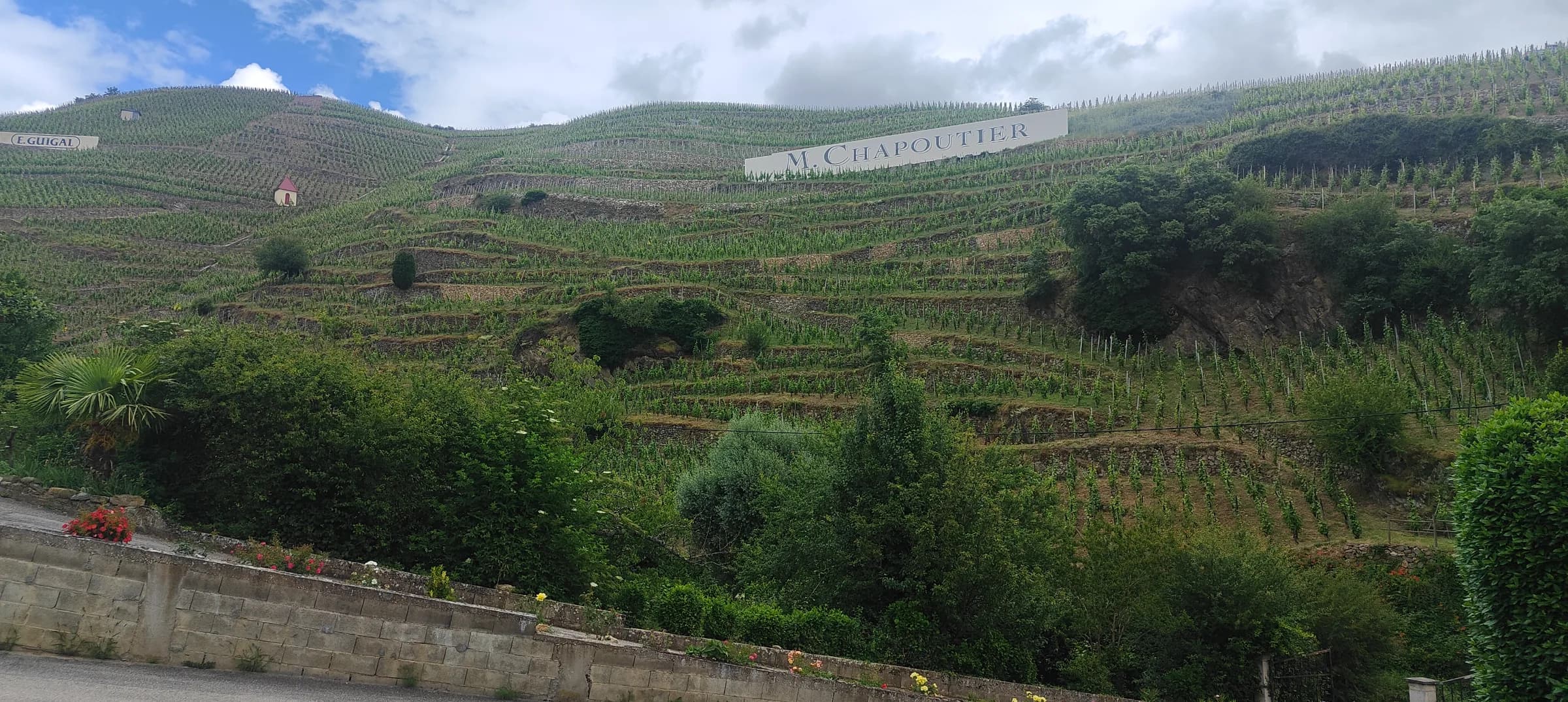
Steep, terraced slopes (30–60°) provide drainage, sunlight, and reflection from the river. All vineyard work is manual, as mechanisation is impossible.
2. Soils and Terroir
The region is dominated by granite and schist, with some gneiss and clay lower down.
Soils and exposures vary across appellations:
- Côte-Rôtie: Schist and mica, divided into:
- Côte Brune: Darker schist; cooler; yields structured, long-lived Syrah.
- Côte Blonde: Paler mica-schist; warmer; gives softer, aromatic wines.
- Condrieu: Decomposed granite (arzelle); low fertility; 100% Viognier.
- Hermitage / Cornas: Granite and loess; warm slopes for powerful, age-worthy Syrah.
- Saint-Joseph / Crozes-Hermitage: Mixed granite and alluvial soils; lighter styles.
- Saint-Péray: Limestone and clay; white and sparkling Marsanne/Roussanne.
3. Grape Varieties
| Grape | Acidity | Tannins | Style / Flavours | Hazards |
|---|---|---|---|---|
| Syrah | Medium–High | High | Blackberry, violet, black pepper, olive, smoke | Coulure, Mistral wind |
| Viognier | Low | — | Apricot, peach, honeysuckle, ginger | Coulure, frost, over-ripeness |
| Marsanne | Medium | Medium–High | Pear, almond, honey, wax | Vigour, coulure |
| Roussanne | High | High | Citrus, floral, nutty | Poor fruit set, rot |
Syrah is the only red grape, reaching its northern limit here. Viognier is sometimes co-fermented (up to 20%) with Syrah in Côte-Rôtie to enhance perfume and colour stability.
4. Vineyard Management and Yields
Vines are individually staked (échalas) to resist the Mistral.
Terraces prevent erosion but make work labour-intensive.
Typical densities: 8,000–10,000 vines/ha on terraces; 3,000–5,000 vines/ha on flatter sites.
Yields are low: 30–45 hL/ha, depending on appellation.
5. Appellations
- Côte-Rôtie: Syrah (with up to 20% Viognier). Elegant, perfumed, long-lived.
- Condrieu / Château-Grillet: 100% Viognier; rich and floral.
- Saint-Joseph: Syrah reds, Marsanne/Roussanne whites; varied in style.
- Hermitage: Syrah of power and longevity; whites from Marsanne/Roussanne.
- Crozes-Hermitage: Largest AOC; softer, early-drinking Syrah.
- Cornas: 100% Syrah; warm, full-bodied, dark wines.
- Saint-Péray: Still and sparkling whites from Marsanne and Roussanne.
6. Winemaking
Reds: Open-top fermentation, gentle extraction, oak aging (12–36 months).
Whites: Fermented in oak or stainless steel; lees aging adds texture.
Trends: Less new oak, more whole-bunch fermentation for freshness.
7. Production and Key Facts
Total vineyard area: ≈ 4,800 ha.
Annual output: ≈ 250,000–300,000 hL (25–30 million L).
Reds ≈ 90%, Whites ≈ 10%.
Key Hazards: Mistral, erosion, coulure, frost.
Top producers: Guigal, Chave, Chapoutier, Jamet, Vernay.
8. Summary
The Northern Rhône produces world-class Syrah—from perfumed Côte-Rôtie (Côte Brune and Blonde) to powerful Cornas—and distinctive whites from Viognier, Marsanne, and Roussanne.
Steep slopes, granite soils, and artisanal winemaking yield small quantities of intensely expressive wines, making this one of France’s most prestigious fine-wine regions.
Check your knowledge
Enthusiast quiz